Operational Data Analytics: Mind the Gap


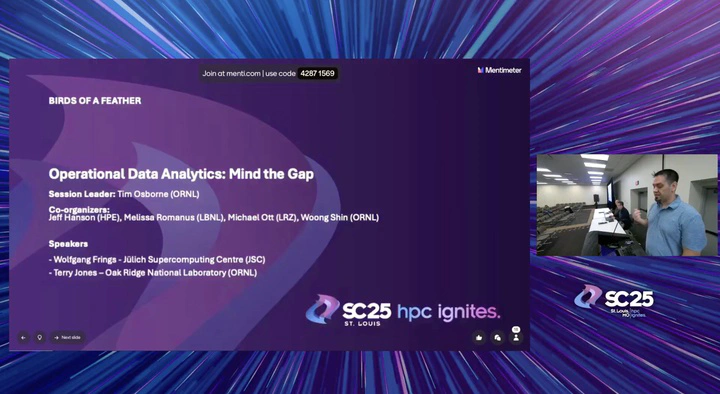
Americas Center Convention Complex, Room 231-232
701 Convention Plaza, St. Louis, Missouri 63101
Session Overview
The SC25 ODA BoF ran as a 60-minute interactive session built around a central question: how do we close the gap between operational data and the people who need it? The format combined short presentations with a live Mentimeter discussion across three stakeholder perspectives.
- 5 min — Introduction and framing
- 5 min — Audience survey (who is in the room)
- 10 min — Wolfgang Frings (Jülich Supercomputing Centre) on LLView, a job-centric monitoring and reporting system
- 10 min — Terry Jones (Oak Ridge National Laboratory) on ExaDigiT and application fingerprinting
- 30 min — Mentimeter-driven discussion with systems operators, researchers, and HPC users
- Remainder — Q&A and free-form exchange
Tim Osborne (Oak Ridge National Laboratory) moderated the session.
Community Pulse
Twenty-nine attendees responded to the Mentimeter survey: 17 systems operators, 11 researchers, and 1 HPC user. The audience distribution itself became part of the conversation, underscoring how rarely the three communities sit in the same room.
Highlights from the responses:
- Top ODA use case: Performance Monitoring and Optimization (4.3 / 5), followed by User Behavior and Resource Utilization (3.8) and Job Scheduling (3.7).
- HPC user gap: Users rated operational data as highly valuable (4.3) but rated their own capability to use it at only 2.9.
- Researcher access: Researchers rated the quality of publicly available ODA datasets at 1.6 / 5.
- Community-wide gaps: knowledge sharing and data standardization surfaced as the two most persistent obstacles.
Continuing the Conversation
Discussion continued immediately after the BoF at the HPE suite (Landmark 3, Marriott St. Louis Grand), extending the exchange between operators and researchers.
Historical Context
SC25 marked the ninth year of the ODA Birds-of-a-Feather series. The 2025 theme, “Mind the Gap,” built on prior themes of software-stack maturity, data abundance, standardization, and the data journey, shifting the focus to the human and institutional barriers that still separate data producers from data consumers.